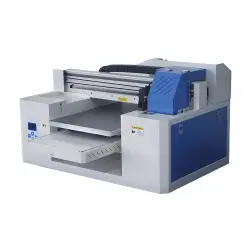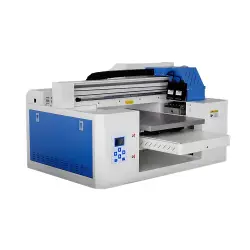
DTG Printers & Direct-to-Garment T-Shirt Printing Machines
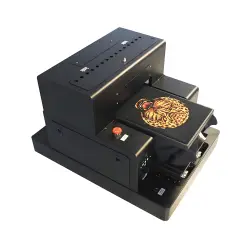
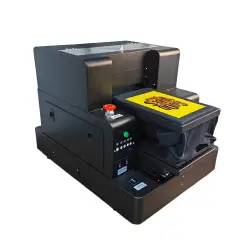
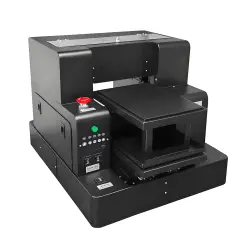
Direct-to-garment (DTG) printing offers e-commerce apparel brands, custom t-shirt shops, and contract screen printers the ultimate capability to print photographic, full-color designs directly onto natural fabrics with zero setup costs and no minimum order sizes. Explore our comprehensive lineup of flatbed printing machinery powered by genuine Epson printheads. For industrial-scale print operations seeking maximum throughput, we also source, supply, and support commercial-grade OEM equipment, including the Ricoh Ri 1000, Ricoh Ri 2000, Epson SureColor F2100, and Epson SureColor F3070 systems.
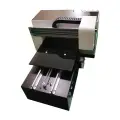
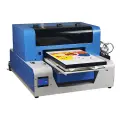
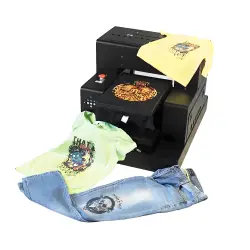
GNFEI DTG Printer Range Specifications
Compare print size, printheads, and production speed across our A4, A3, and A2 direct-to-garment-printer models.
| Specification | A4 Entry DTG Printer | A3 Pro DTG Printer | A2 Advanced DTG Printer |
|---|---|---|---|
| Maximum Print Size | 210 × 297 mm (A4 Format) | 329 × 600 mm (A3+ Format) | 420 × 600 mm (A2 Format) |
| Compatible Printheads | Genuine Epson L805 / TX800 | Epson TX800 / DX5 / L1800 | Dual Epson XP600 / TX800 Setup |
| Ink Channels & Colors | 6 Channels (CMYK + WW) | 6/8 Channels (CMYK + WWWW) | 12 Channels (CMYK + WWWW + Varnish) |
| Recommended Daily Volume | 10 - 20 T-Shirts / Day | 25 - 50 T-Shirts / Day | 60 - 120 T-Shirts / Day |
| Best Suited For | Startups, pocket prints, sleeves | Standard custom T-shirt shops | High-speed apparel fulfillment |
Watch Our DTG Printers in Action
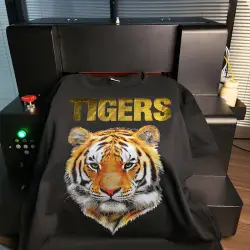
See our flatbed digital printing machines lay down CMYK and white ink layers on light and dark cotton garments.
DTG vs. DTF vs. Screen Printing
Understand the trade-offs in setup, feel, and cost to pick the best textile method for your business model.
| Factor | Direct to Garment (DTG) | Direct to Film (DTF) |
|---|---|---|
| Fabric Suitability | 100% Cotton & high-cotton blends | Universal (Polyester, nylon, cotton, spandex) |
| Hand Feel / Comfort | Ultra-soft, breathable (soaks into fabric) | Thin rubber/plastic sticker feel (sits on top) |
| MOQ Requirement | No minimum order (1-unit printing is highly profitable) | No minimum order (requires separate transfer step) |
| Pretreatment | Required for dark fabrics (liquid pre-spray) | No garment pretreatment (powder adhesive on film) |
| Fine Details / Gradients | Exceptional, photographic gradient reproduction | High detail, but solid boundaries |
Frequently Asked Questions — DTG Printers
Review technical answers regarding direct-to-garment systems, setup pricing, fabric guidelines, and support.
Q1. What is the difference between DTG and DTF printing?
DTG (Direct to Garment) prints ink directly onto the fabric, allowing it to sink into the fibers. This produces a soft, breathable finish that feels exactly like screen printing. DTF (Direct to Film) prints onto a clear transfer film, which is then covered with powder adhesive and heat-pressed onto the garment. DTG is highly preferred for premium 100% cotton clothing due to its high breathability and superior touch, while DTF is excellent for polyester sportswear and custom sleeve tags.
Q2. How much does a commercial DTG printer cost?
DTG printer pricing ranges based on format and speed. Entry-level desktop models typically start from $1,400 to $3,000, offering small businesses and startups a high-ROI entry point. Professional mid-range models (like A2 size) cost between $4,000 and $9,000. High-volume commercial systems (such as Ricoh Ri 1000/2000 or Epson F2100/F3070) range from $12,000 to over $25,000. GNFEI provides factory-direct prices with no middleman markup, ensuring high affordability.
Q3. Can GNFEI supply industrial DTG printers like Ricoh or Epson?
Yes. While we manufacture our own line of cost-effective GNFEI A4, A3, and A2 flatbed printers, we also work closely with major commercial manufacturers. We source and supply commercial-grade OEM equipment, including the Ricoh Ri 1000, Ricoh Ri 2000, Epson SureColor F2100, and Epson SureColor F3070. This allows industrial print operations to bundle equipment, secure volume pricing, and establish unified logistics through us.
Q4. How do I print on black and dark-colored t-shirts?
To print on dark t-shirts and hoodies, you must use a DTG printer equipped with a white ink system. First, spray a thin layer of DTG pretreatment liquid on the print zone and cure it with a heat press. Then, the printer lays down a solid white ink underbase layer, followed immediately by the CMYK color pass. This prevents the colored ink from absorbing into the dark fabric, keeping prints exceptionally bright.
Q5. What printheads do GNFEI printers utilize?
GNFEI flatbed DTG printers utilize genuine, industrial-grade Epson printheads (such as TX800 or L805 variants depending on the model tier). These heads feature micro-piezo technology for sub-millimeter print accuracy and excellent gradient details. For high-end industrial OEM configurations, we supply systems running Ricoh GH2220 or Epson Gen5/Gen6 printheads designed for maximum speed.
Q6. What fabrics are compatible with DTG printing machines?
DTG water-based inks require natural fibers to bind properly. The best results are achieved on 100% cotton, combed cotton, ringspun cotton, canvas, and denim. Cotton-polyester blends are fully supported, provided the cotton content is at least 60%. Synthetics like pure polyester or nylon do not absorb the ink well and are better suited for DTF or sublimation printing.
Q7. What are the daily maintenance requirements to prevent nozzle clogging?
Because white ink contains titanium dioxide, it can settle and clog nozzles if left idle. Our printers feature auto-circulation and stirring systems to keep white ink flowing during standby. Daily maintenance takes under 5 minutes: a simple nozzle test print on startup, and a wipe of the printhead capping station at shutdown. If the machine is going to sit idle for more than a week, we recommend flushing the ink lines with cleaning solution.
Q8. Do your printers ship fully assembled?
Yes, all GNFEI printers ship fully assembled in secure, reinforced wooden crates. You only need to unpack the machine, install the ink tanks, install the included RIP software on a Windows computer, and perform the initial calibration run. We provide step-by-step video tutorials and configuration files to get you up and running within 2 hours of delivery.
Q9. What RIP software is compatible with GNFEI DTG printers?
Our machines are fully compatible with AcroRIP, Wasatch SoftRIP, and ErgoSoft. We include a lifetime license of RIP software with every printer purchase. The RIP software lets you adjust color profiles, control ink density, and configure white ink underbase settings to match dark fabric types perfectly.
Q10. What warranty and post-sales technical support do you offer?
Every printer ships with a 12-month hardware warranty (excluding consumable parts like capping stations and printheads which are subject to regular wear). Lifetime technical support is provided by our dedicated engineering team in English. We offer remote troubleshooting, video call assistance, and fast shipping for replacement spare parts from our warehouse.